The Unexpected Side Effects of Healing: How changing one part of your life can quietly change everything else
Something happened to me this week that stopped me in my tracks.
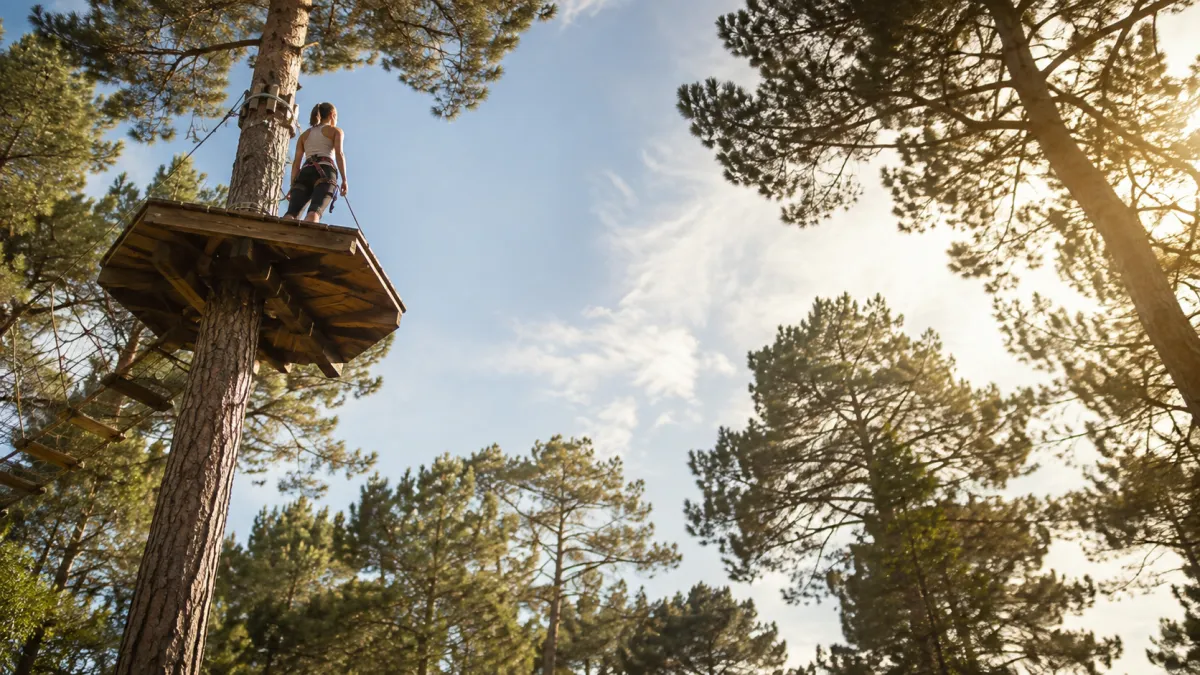
I was climbing trees with my son and when I got to the top I realised something: I wasn't afraid. I mean, not "less afraid". I wasn't trying to be brave or telling myself, "Come on, Kate, you've got this." There was nothing. I was simply up in a tree, and I felt completely fine.
The strangest thing? I've been afraid of heights my entire life.
I hadn't specifically been working on my fear of heights. It wasn't a block I'd been consciously trying to rewire. I hadn't been doing exposure exercises or telling myself that heights were safe. I was just there, climbing a tree with my son. I was about six metres up in the air (all in harness, I'm not crazy 😂) when suddenly it hit me. I wasn't afraid. Not even a little and that's when I realised something:
When you start changing yourself in one area of your life, you don't always get to choose where the changes show up.
Sometimes healing has side effects and some of them are beautiful. And I'm pretty chuffed about this one, to be honest :)
The things we think we're working on aren't always the things that change

When we begin doing inner work, we tend to have a very specific goal.
Maybe you want to stop overthinking, you want to feel more confident, have healthier relationships, want to stop people-pleasing, feel safer receiving love, want to change your relationship with money or you want to stop living in survival mode.
Whatever it is, you focus on this and work on that thing.
When you learn about your nervous system and become aware of your patterns, you also start noticing your triggers. For me, one of the biggest shifts was learning to pause before reacting. To become curious about my thoughts instead of automatically believing them and I started noticing something: The changes weren't staying neatly inside the box I'd created for them.
Guess what? Because we're human, we tend to expect a very linear result.
I work on this → this gets better.
But our brains are far more interconnected than that.
The learning that happens through repeated experiences isn't stored in one isolated little compartment labelled "relationship issues"; "confidence" or "fear of heights." Our brains are constantly integrating information about our environment, our experiences, our memories and what we should pay attention to or prepare for and that's where things get really interesting.
Your brain is constantly learning what to expect

One of the most fascinating things about the brain is its ability to change with experience.
It's called neuroplasticity.
Very simply, your brain isn't completely fixed. Learning can alter the strength and organisation of connections within neural networks. Did you know that when it comes to fear, researchers have discovered something particularly interesting? When an old fear response is repeatedly followed by experiences of safety, the brain can learn something new. This is often studied through something called fear extinction.
But there's an important distinction here. Fear extinction doesn't necessarily mean the old fear memory has been completely deleted. Instead, new learning can create a competing association:
"This thing that once meant danger doesn't necessarily mean danger anymore."
Your brain can learn a new response. So, sometimes that new response becomes so familiar that you don't even notice the change happening. Until one day, you're standing on a wooden platform in a tree and you realise: "Wait. Where did my fear go?"
Maybe healing is more like updating the whole system

This is the part that fascinates me.
Imagine your brain as an incredibly sophisticated system that's been collecting information about the world your entire life. Some of that information is useful, some of it is outdated, some of it was learned when you were very young, some of it came from things that happened to you, some of it came from watching other people and some of it came from experiences that taught you:
"This is safe." or "This isn't safe."
Your brain doesn't sit there judging whether those lessons are still relevant. It learned them because they were useful at the time. And this is one of the reasons I don't believe we should look at our patterns with shame.
And this is where safety becomes so important
I've talked a lot recently about nervous system regulation and feeling safe and I think this recent experience made me realise something.
Safety isn't about becoming someone who is never afraid; it's not about being calm all the time and it's definitely not about eliminating every uncomfortable feeling. It's about creating enough flexibility that an old protective response doesn't have to run the entire show.
Because when your system learns: "I can handle this. I'm okay here. I don't have to react the way I used to." something begins to change.
You may notice that you're less reactive, calmer; you might recover more quickly after something stressful; you might stop needing to control every situation or you might find yourself setting a boundary without spending three days worrying about whether you've upset someone (yes, I used to be that person who would always question every message I sent).
You might receive a compliment without immediately dismissing it or you might ask for more money without feeling like you've committed a crime because you feel worthy of it.
Or, like in my case, you might climb a tree and realise you're no longer afraid of heights and feel pretty epic about it.
The most beautiful changes can be the ones you weren't looking for

I personally think we often make healing far too transactional.
We want: "I want to fix my anxiety, my relationship, my money block, my confidence."
And there's absolutely nothing wrong with having goals, but what if you stop and think a little differently? What if the work you're doing is creating something much bigger? What if learning to regulate your nervous system doesn't just change how you feel in one area of your life?
What if it changes the way you experience your entire life?
And please don't turn this into another thing you have to achieve
This is important. I don't want you reading this and thinking: "Right. I need to rewire my brain now."
Please don't. It isn't the purpose of this article. You don't need another thing on your to-do list (I'm sure our lists have plenty of things to tick off). You don't need to obsessively monitor yourself for signs of healing, you don't need to analyse every reaction and you certainly don't need to force yourself into situations that genuinely frighten you just to prove that you've changed.
My experience with the tree wasn't me forcing myself to overcome my fear.
It was the opposite. I didn't even think about it. That's what made it so beautiful; the change had happened quietly.
Sometimes you only discover who you've become when life gives you an old situation
I think that's the real side effect of healing: you don't necessarily wake up one morning thinking: "I don't think I do this anymore." Instead, you just live your life, you have conversations differently, you respond to situations differently, you make decisions differently. If you receive something, you don't push it away. You tolerate uncertainty without spiralling. You choose yourself without guilt. You simply do something you once thought you couldn't do.
And then the realisation hits:
"Oh. I don't do that anymore. I don't feel that anymore. I'm not afraid of that anymore. When did that happen?"
That's the bit I experienced in that tree. And honestly? It felt like one of the most beautiful side effects of all. And it made all the healing I've done so far, all the tears I've shed, feel so freaking worth it.
So here's what I want you to do
Don't look for some huge transformation today.
Instead, I want you to ask yourself: "Where am I different now than I was a year ago?"
Maybe you'll find something obvious or something tiny. Maybe you'll remember a situation that used to completely derail you and realise that now you simply handle it without even thinking about it. Maybe you'll realise you finally stopped chasing someone who wasn't choosing you.
Don't think about what you still need to fix. Think about what has already changed.
Because maybe you've been so focused on where you're going that you've forgotten to look back and notice how far you've already come.
Your Unexpected Evidence

Take two minutes and write down three things you do, tolerate or experience differently now than you did a year ago.
1.
2.
3.
Don't dismiss the small things.
Sometimes the smallest changes are evidence that something much bigger has shifted underneath.
With love,
Kate x

If you've enjoyed this article, you might also enjoy reading Your Reality Will Never Outperform Your Standards, where I explore why the standards you set for yourself quietly shape the reality you experience every day.
